
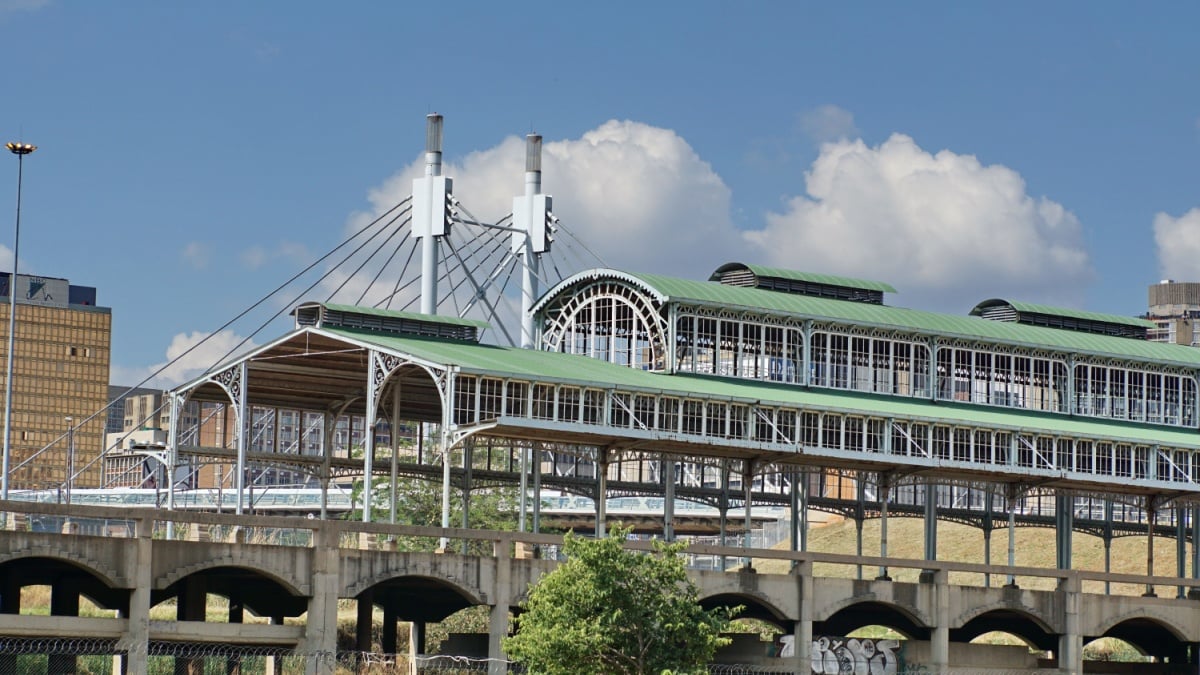
Joburg train station abandoned for 24 years makes a comeback
Located in the heart of Johannesburg’s historical CBD is the Old Park Station, one of the oldest surviving structures in the city that has been converted into an events space. The station is a rare architectural gem that has been standing since before the Anglo-Boer War, with it opening to passengers in 1897.
Commissioned by the Zuid Afrikaansche Republiek, the station was also the birthplace of Transnet, which was formed out of Park Station’s operator, the Netherlands South African Railway Company. The Old Park Station was also a feat of engineering, with the entire structure being fabricated in the Netherlands and assembled in Johannesburg.
It was the largest single exercise in prefabricated architecture outside of the Witwatersrand gold mines. Conservation architect Frances Woodgate estimated that the structure is the most travelled building in Johannesburg, transporting 16 million passengers a year at its height.
Strangely, for such an old building, the station has hardly stood still over its nearly 120-existence. Being prefabricated, the structure could be easily disassembled and moved to suit the needs of the government. As a giant kit of parts, it was shipped from Rotterdam to Cape Town, from where it was transported to its original site at Park Station in Johannesburg.
This effectively split the city’s CBD into two parts, with the area south of the station being heavily developed and commercial while the northern area would be more residential. The position was based on the location of a tiny tin shed that stood at a spot called ‘Park’ by the locals after Kruger’s Park just north of the stop.
The park’s name would change in time to Old Wanderers. This shed was conveniently located along a railway line from Boksburg to Braamfontein and would become known as Park Halt on the line, transporting coal into the city. The erection of the station that still stands today began in 1896 and was completed a year later, including offices and restaurants.
It was also relatively opulent for the time, with a glass-domed roof and the offices and restaurants being made of carved oak. However, in 1952, the structure was dismantled and moved 45 km to the Transnet railway training college at Esselenpark to make way for the redevelopment of the Park Station complex.
In 1993, the structure was dismantled again and transported another 45 km to this site in Newtown, with the ambition of it becoming a Railway Museum. Woodgate said the total distance travelled by the station itself is approximately 15,250km: nearly twice the full length of the African continent.